
Category Archives: Research

#Whatwouldyougive FAQs

Yesterday, I launched a new fundraising campaign called #whatwouldyougive. I did this because I wanted to create a fundraiser that helped people understand just a bit of what it feels like to be stripped of the basic abilities that ALS takes away. The things that most of us take for granted. The things that I absolutely took for granted until I received an ALS diagnosis when I was 33 years old. I’m 36 now, and even after all I’ve given up, I’m not giving up.

While most fundraisers center around a physical activity that requires ability, this one is about the things ALS takes away. During the week of August 1-8, team members spend a day (or an hour) giving up an ability in an effort to *begin* to understand what life is like for a person with ALS.

Examples: Have someone feed you meals or brush your teeth; type on your phone to communicate. This experience is a fraction of what people with ALS deal with, all day, every day. What would you give in order to live normally again? What would you give to end this disease? Each team member reaches out to their network to raise money around their efforts.

Our team is raising money for ALS TDI, the largest nonprofit biotechnology organization dedicated to developing effective treatments for ALS. With more attention and funding, we can find treatments and an eventual cure for ALS.

Here are a few FAQs to help people better understand the concept and how to get involved. All support is so appreciated! Read More>
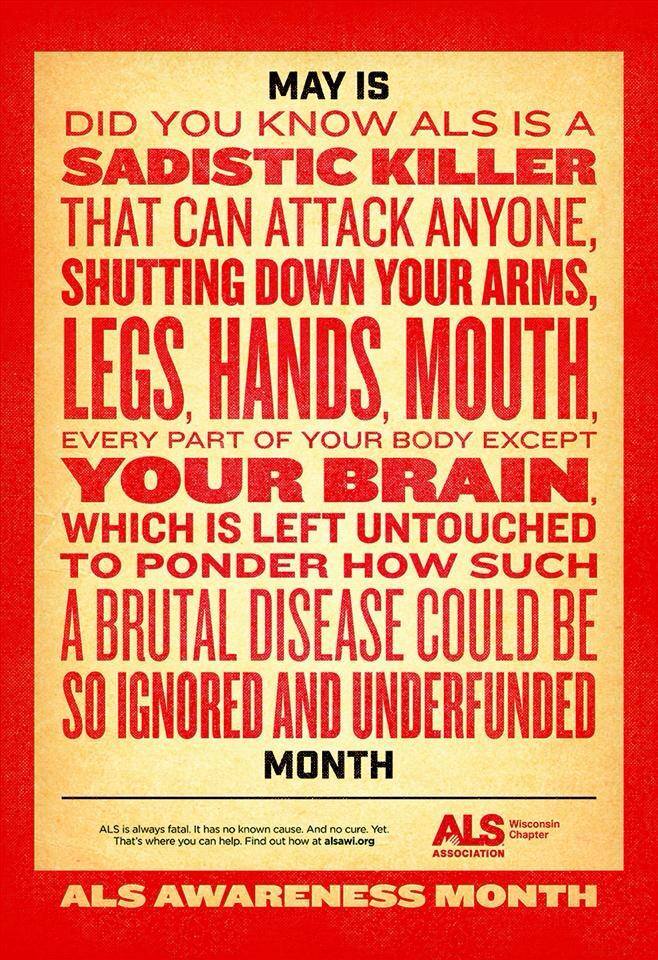
ALS Awareness Month

May is ALS Awareness Month. Last year at this time, I changed the Speed4Sarah Facebook profile picture to this:

I like to stay optimistic about my future, to recognize that no one knows what’s going to happen and that we could, in fact, find a solution to slow down this demon—in my lifetime. But I also appreciate statements like the one above, because I think they help people begin to understand the absolute INSANITY of ALS. It sounds like science fiction, but it happens to people every day. Today, someone will experience the first signs of ALS, and they will have no idea what the hell is going on. Someone (many someones) will be officially diagnosed. People will die of ALS today.

It’s a conundrum for me, as I try to share my love of life on this blog, while not sugarcoating the reality of how everything has changed, and will continue to change.

I am someone who could walk—and who did, even at times when driving made a lot more sense. I am someone who could run—and ran miles. I am someone who cooked—and loved trying new recipes. I am someone who traveled—all over the world.

Those things are gone, and it’s completely true that I’ve found new ways to release stress and find happiness. But I miss my abilities, which now feel more like they were superpowers. Read More>

Brain Power

Scarlett and I paid a visit to one of our favorite doctors, Dr. Steve Finkbeiner, in his lab last week. Dr. Finkbeiner works at UCSF’s Gladstone Institute and is the inventor of robotic microscopy, which is a huge step for modern drug discovery. He’s also just an all-around nice guy, who lets me stop by and bother him, even when I bring a 4-year-old who is still wearing her fairy costume from that day’s Carnevale party at school.

The first time we visited the lab, Dr. Finkbeiner and I chatted about research developments while Scarlett was spirited away by an assistant to make a “neuron” out of styrofoam and pipe cleaners. This time, she stayed with me in the office, manhandling the doc’s extensive collection of toy brains. He has one real brain in formaldehyde that I think is fascinating, but Scarlett was far more interested in the gooey, wind-up brains, and would not stop touching them.

I asked the good doctor to show me which part of the brain is responsible for impulse control and at what point it becomes developed in children. Short answers: The Front Part and Not Yet. Read More>